Why Use Hydrovac for Pile Holes?
Helical piles, sonotube footings and caissons all have the same weak point: something has to make the first hole, and that something usually has teeth. On a GTA lot with gas, hydro and fiber running through the yard or boulevard, an auger is a gamble.
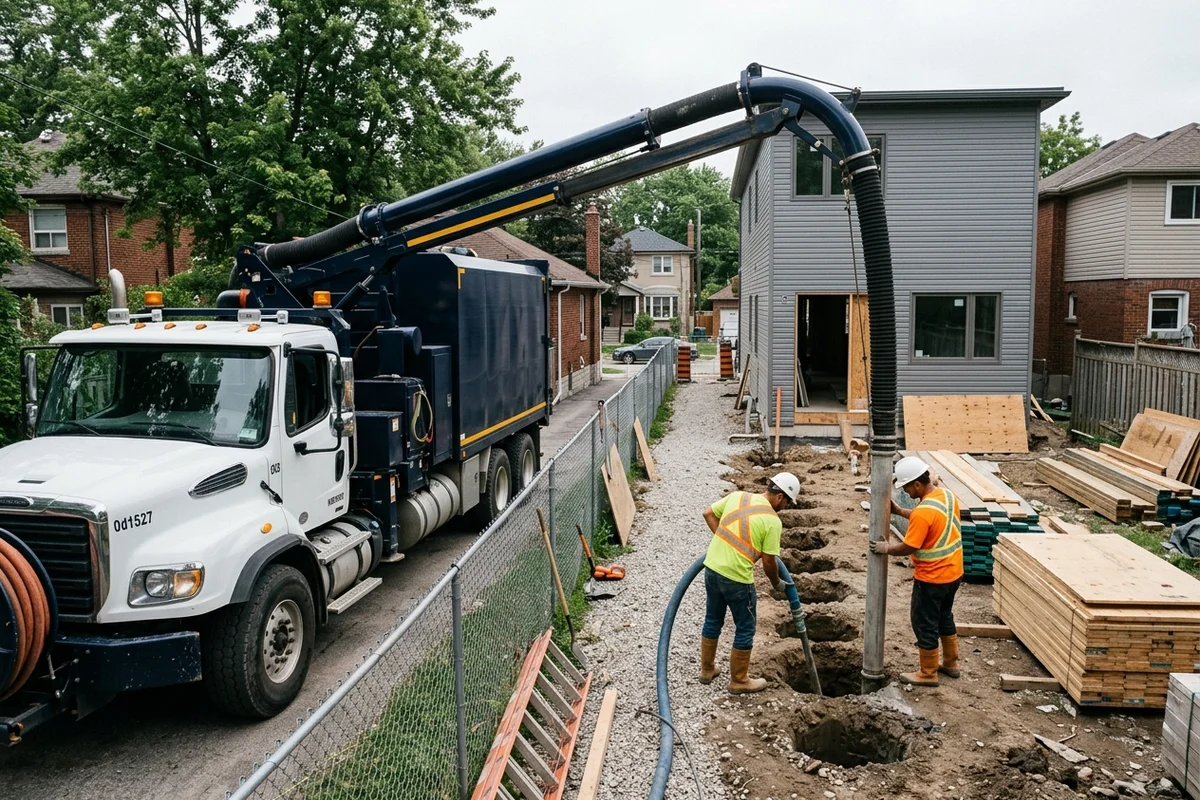
Hydrovac pile hole excavation removes the gamble. Water cuts the soil, the vacuum lifts it, and any service near the hole shows up long before it can be hit. Once the hole is clear to depth, your auger rig or helical driver goes in at full speed. On a site with buried services we expose each one with hydrovac excavation first, and on a long run of locations we often daylight the utility line end to end so the whole layout can be adjusted at once.
What makes a good pile hole
- Plumb. Straight sides keep the pile or sonotube aligned.
- Clean. No loose spoil at the bottom to compress later.
- Stable sidewalls. No vibration, which matters next to existing footings and slab edges.
- To design depth. Below frost depth in the GTA, typically 1.2 m or more for footings.
Pile Hole Methods Compared
| Method | Utility strike risk | Vibration near footings | Spoil handling | Best use |
|---|
| Auger rig only | High on congested lots | Moderate | Piled on site | Open lots, no services |
| Hand digging | Low but slow | None | Piled on site | One or two shallow holes |
| Hydrovac | Near zero | None | In the tank | Any lot with buried services |
| Hydrovac then auger | Near zero | Low | Mostly in the tank | Deep or large diameter piles |
Field note from our crew
Nine times out of ten, this is where the previous contractor cut a corner: they augered the first hole “just to check.” On a Bloor West Village addition that first hole would have landed 200 mm from the gas service. We found it at hole number three, everytime you look at the logs.
Where We Dig Pile Holes Across the GTA
- Toronto infill and additions: Bloor West Village, Leaside, the Beaches and East York, where gas services run close to the house.
- Commercial canopies and pylon signs: Airport Corporate Centre, Dixie Rd and Steeles Ave plazas, full of lighting cable and storm pipe.
- Retaining walls along property lines: Unionville and Markham, where fiber often sits in the boulevard.
- Pearson-area foundations: where a strike on airport infrastructure brings a lot more than a repair bill.
What Affects Pile Hole Cost?
- Number of holes and depth. A 4-6 ft set is $1,200-$3,500 CAD. Deeper caissons bill hourly.
- Soil and frost. Clay and frozen ground take longer. Heated water handles winter work.
- Access. Long hose runs and tight side yards add setup time, not a separate fee.
- Disposal. Spoil leaves in the tank and goes to a licensed facility on its own line.
Every quote shows rate, mobilization, disposal and locates separately. Foundation GCs on commercial projects can book a free on-site assessment.
Helical Pile Installation Prep: Clearing Utilities With Hydrovac First
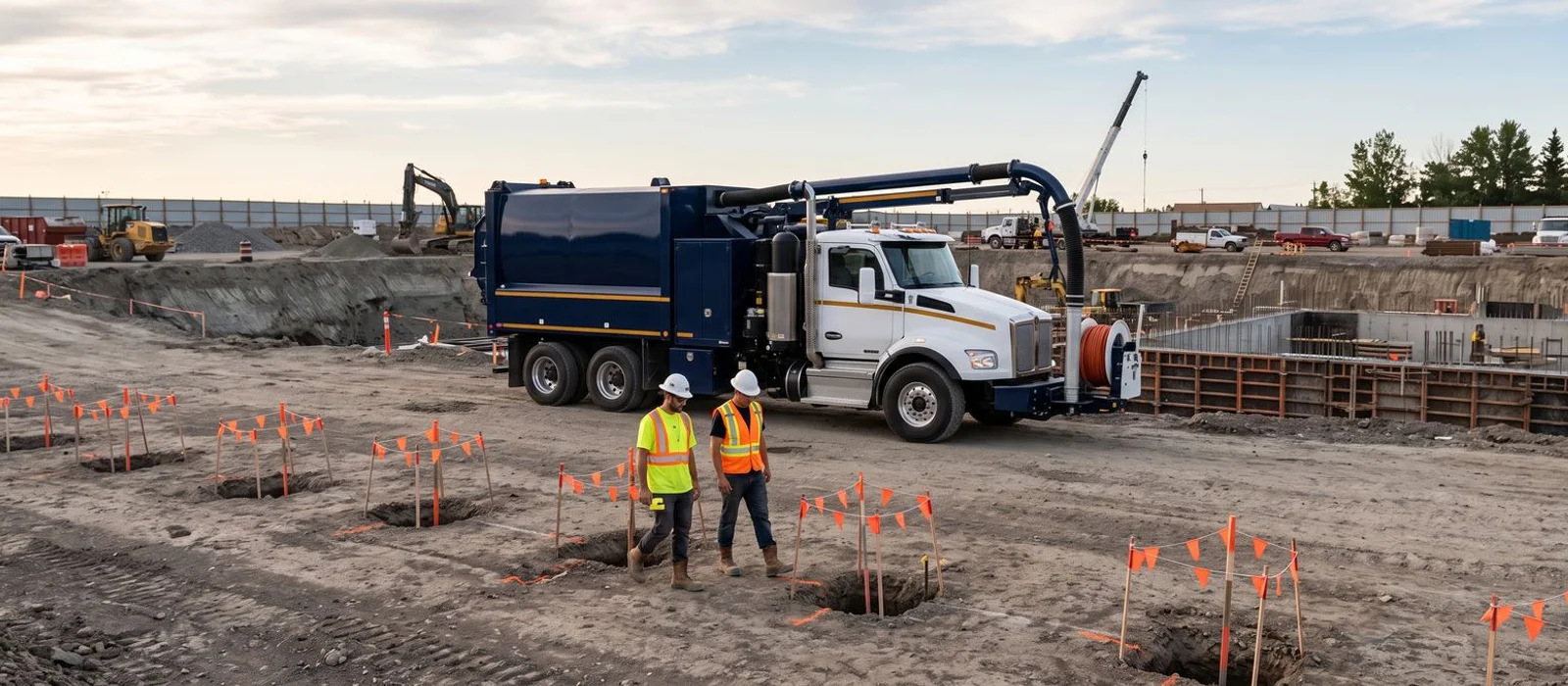
Helical piles turn into the ground under 20,000-50,000 ft-lbs of torque, and a direct hit on a gas distribution main, water line or electrical duct bank at that torque triggers a utility strike before the operator can shut off hydraulics. Clearing every pile location with hydrovac first eliminates that risk. We spray a 24-inch diameter hole at the pile centerline down to 1 metre below the deepest marked utility, verify by sight that nothing crosses the pile shaft path, photograph the exposure for the foundation engineer, and release the location to the auger rig.
A typical GTA residential pile foundation runs 18-32 pile locations. We clear every one in a single day using the Vactor 2100i, log depth and offset per pile, and the auger rig follows our shift. On commercial projects with 60-120 piles, we rotate two trucks ahead of the auger crew so the drill head never waits. We did a foundation GC near Pearson Airport last fall, 18 pile locations through buried telecom and electrical, auger rig followed without a single strike, $9,200 CAD invoice. Trust us, you’re in good hands when the pile count is high and the utility map is dense.
Shoring Prep: How Hydrovac Clears the Way Before Soldier Pile and Sheet Pile Shoring Installation
Shoring installation (soldier pile with timber lagging, sheet pile walls, secant piles and tangent piles) depends on a clean shoring line with every buried utility exposed, measured and documented before the shoring rig lands. A soldier pile driven through a gas distribution main or an electrical duct bank triggers a utility strike at full driving torque and stops a Toronto downtown excavation project for days. We are not a shoring installer — soldier pile installation, timber lagging placement and tie-back drilling are specialized trades with their own equipment and tickets — but we are the hydrovac clearance crew most GTA shoring contractors call first.
A typical Toronto downtown shoring prep job looks like this: the shoring contractor sends us the shoring line drawing with every pile location flagged. We verify Ontario One Call locates across the full shoring footprint, then run 3,500 PSI water and 27 inch Hg vacuum to expose every utility crossing the shoring line to a depth of 1-2 metres below the deepest marked service. Depth, offset and material are logged per pile location. The shoring contractor arrives on day two with a clean line and no utility surprises. Everytime we work the clearance side of a shoring job in the GTA, the shoring installation finishes faster because the first-day surprises are already handled.
Cost for a Toronto shoring prep job runs the same hourly rate as standard pile hole work: $400-$600 CAD per hour depending on utility density, or $4,000-$18,000 as a project rate for most downtown projects. Published separately from the shoring contractor’s rate so you see each line clearly on the quote.