What Is Utility Daylighting?
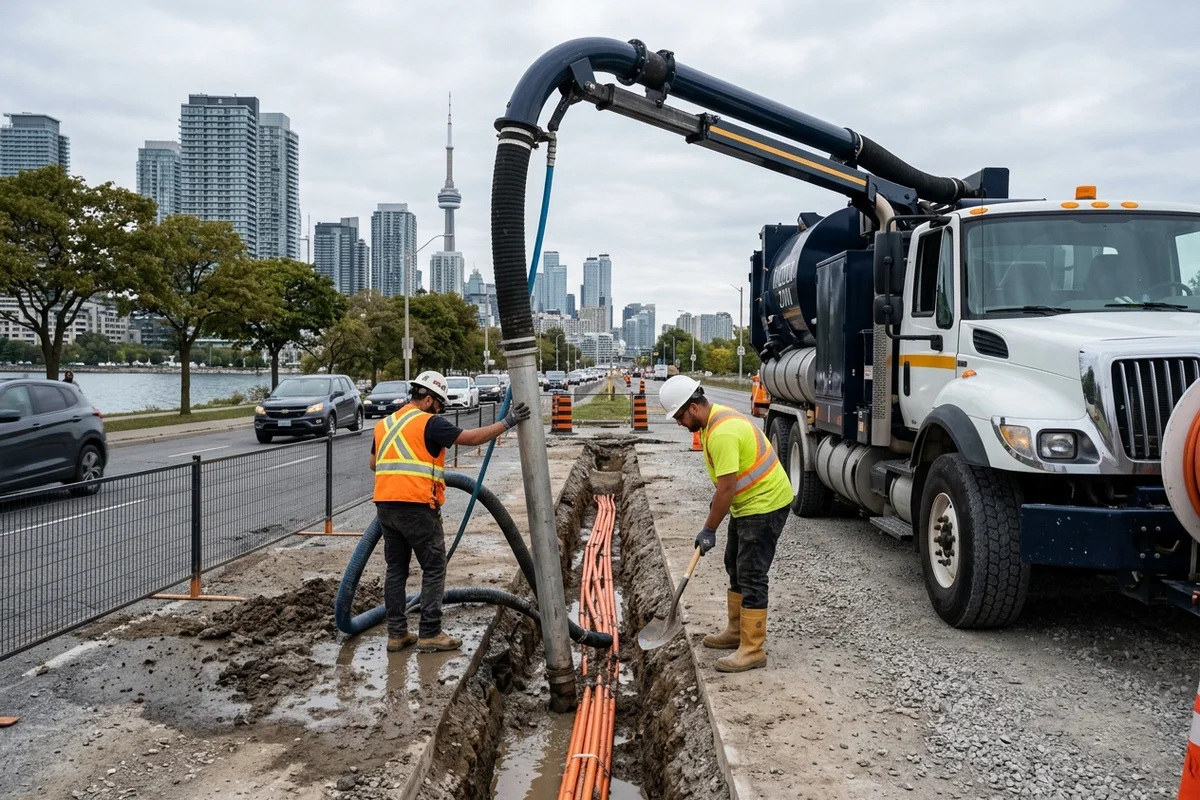
Utility daylighting means exposing a buried service so you can see it. A crew uses a pressure wand to loosen the soil around the locate mark, and the vacuum lifts it out until the pipe, cable or duct bank is visible. Then we measure. Depth to top, outside diameter, material, condition and offset from a fixed reference all go onto a log sheet with photos.
Locate paint from Ontario One Call shows horizontal position within a tolerance zone. It does not show depth, and in older parts of Toronto it can be off by more than you would like. Daylighting closes that gap. It is the field step that produces Subsurface Utility Engineering (SUE) Quality Level A data, the only level where the utility is physically seen.
If you also need the hole opened up for a crossing, tie-in or footing, the same crew switches to hydrovac excavation. For a narrow trench along the corridor afterward, we run slot trenching.
What we record at every exposure
- Depth to top of utility, measured from finished grade
- Outside diameter and material (steel, PE, cast iron, concrete-encased duct, HDPE conduit)
- Horizontal offset from a fixed point or survey control
- Coating or jacket condition, with photos from two angles
- Tracer wire presence and any unrecorded lines found
Where Toronto Projects Need Daylighting Most
- Before HDD bores. Every crossing on the bore path, so the drill head never finds a cable by surprise.
- Inside the gas tolerance zone. Mechanical excavation is not allowed near an Enbridge main until it is exposed.
- Shoring, piles and footings near duct banks. You need both edges and the top of the bank, not a centreline.
- Design verification. Engineers want real depths before drawings are stamped.
- Conflicting or faded marks. A few test holes cost less than a redesign.
Field note from our crew
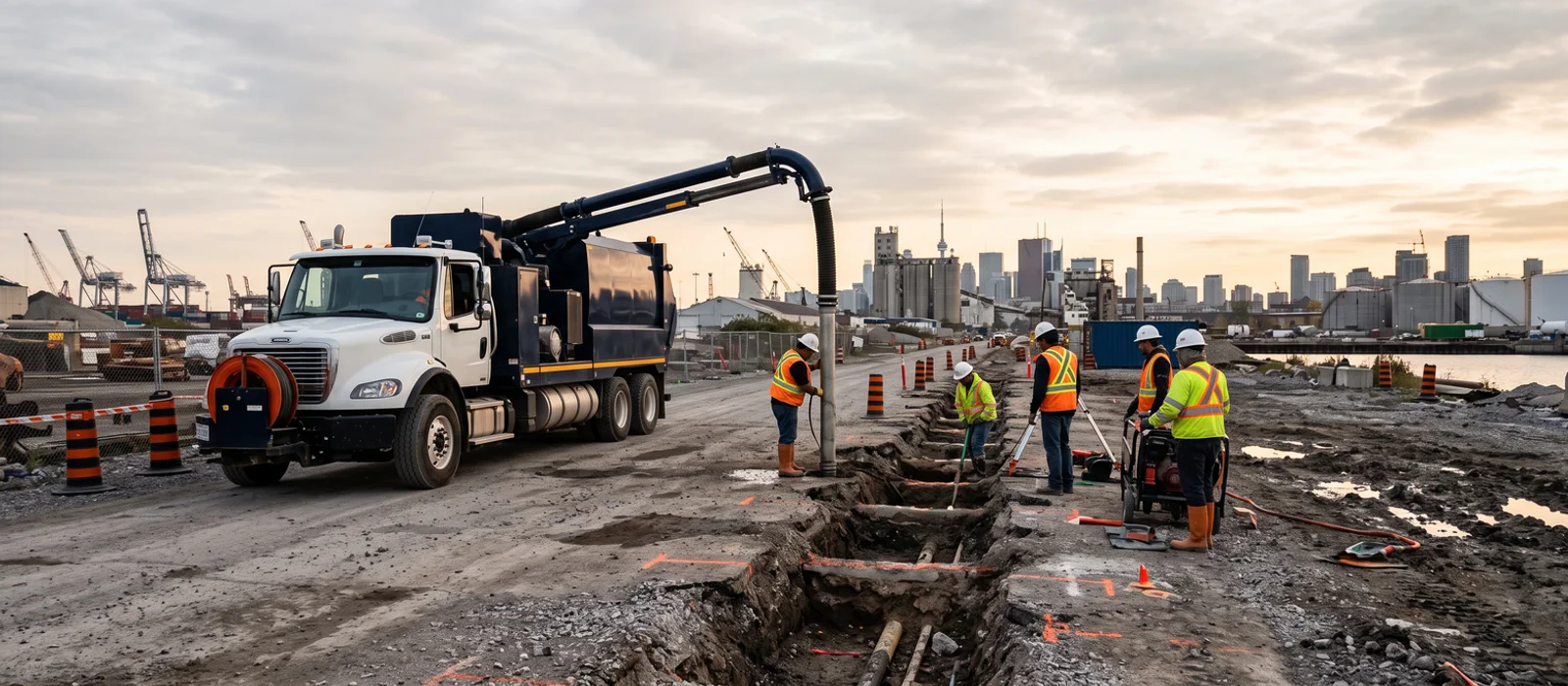
Hydrovac to a buried utility is like a dental X-ray to a tooth: you want the picture before you reach for the drill. On a Port Lands fiber corridor we found two lines nobody had marked. The client had already had one dig-in that year with another crew.
Daylighting vs Electronic Locating vs Ground Penetrating Radar
| Method | What it tells you | Depth accuracy | Finds non-metallic lines? |
|---|
| Electronic locate (paint) | Approximate horizontal position | None to rough | Only with tracer wire |
| Ground penetrating radar | Anomalies in the soil | Estimated | Sometimes |
| Daylighting (hydrovac) | The actual line, seen and measured | Exact | Yes |
Electronic locating and GPR are useful for planning where to dig. Daylighting is how you confirm it. The three work together, and our crews coordinate with your locator on site.
What Affects Daylighting Cost in Toronto?
- Depth and soil. Shallow fiber in sand is quick. Deep gas mains in clay take longer.
- Number of exposures or run length. Per-hole, per-run or hourly, whichever fits.
- Traffic control. Lakeshore, Highway 7 and downtown streets need more setup than a private lot.
- Disposal. Slurry hauled to a licensed facility on its own line.
- Documentation level. Standard logs are included. Survey-grade SUE deliverables are scoped up front.
Every quote itemises hourly rate, mobilization, disposal and locate coordination. Commercial projects across the GTA get a free on-site assessment, and the quote you recieve reflects the actual run, not a template.
Ontario One Call Locates: How Dial-Before-You-Dig Works on GTA Projects
Every daylighting job in the GTA starts with an Ontario One Call ticket, filed online or by phone at least five business days before the first spray. The ON1Call notification goes out to Enbridge Gas, Toronto Hydro, Bell Canada, Rogers, the municipal water department and any private utility registered on the parcel. Each utility sends its own locator to mark buried infrastructure with paint and flags, and each returns a signed completion notice.
The locate ticket is only the start. Paint marks show horizontal position within a tolerance zone defined by the utility owner, usually 1 metre either side of the mark for pressurized gas and 0.5 metre for telecom. Depth is not marked, so a bucket cannot work from paint alone. That is where daylighting comes in: the 3,500 PSI wand and 27 inch Hg vacuum visually verify the exact position and depth before any mechanical excavation starts. We photograph the locate flag, the exposed utility and the depth reading at every pothole for your project file. Trust us, you’re in good hands when the inspector reviews the sign-off package.
Is Hydrovac Safe Around Gas Lines and Fiber Optic Cable?
Hydrovac is the safest exposure method for buried gas and fiber optic cable because the 3,500 PSI pressurized water lance cannot nick steel pipe, polyethylene gas distribution main or armored fiber bundle. A bucket on a backhoe scars the pipe wall even on a glancing strike. Our water wand sprays past the utility at a tangent, lifts soil off the top and sides, and leaves the pipe surface untouched for the Enbridge or Bell inspector to photograph.
The real risk on gas and fiber work is heat and water conductivity around high-voltage joints. We shut off water flow before reaching 300 mm from any marked electrical duct bank, switch to light hand excavation for the final clearance, and verify the duct bank with the Toronto Hydro locator present. Nine times out of ten, the previous crew cut a corner here. Our depth log shows every exposure down to the millimetre so the utility owner has no reason to question the first-visit sign-off.
Daylighting for HDD and Trenchless Crossings: Bore Path Verification
Horizontal directional drilling and trenchless crossings depend on an accurate map of every buried utility within 2 metres of the bore path, with elevations verified to within 50 mm. We daylight the entry pit, the exit pit and every intermediate potholing station along the designed path, record depth and offset at each one, and hand the data to the HDD operator before the bore starts. One missed crossing on a 100-metre bore can mean a $30,000 CAD strike and a stop-work order from the utility.
A typical GTA fiber corridor runs 300-500 metres with 6-12 required potholing stations. We stage the hydrovac truck ahead of the bore crew, work from the entry pit forward, and keep 2 potholing stations ahead of the drill head at all times. Every exposure is photographed and logged against the station chainage on the bore plan. The HDD operator steers around the verified utilities without guessing. Everytime we work with a trenchless crew that follows this sequence, the bore finishes on schedule.