What Is Hydro Excavation and How Does It Work?
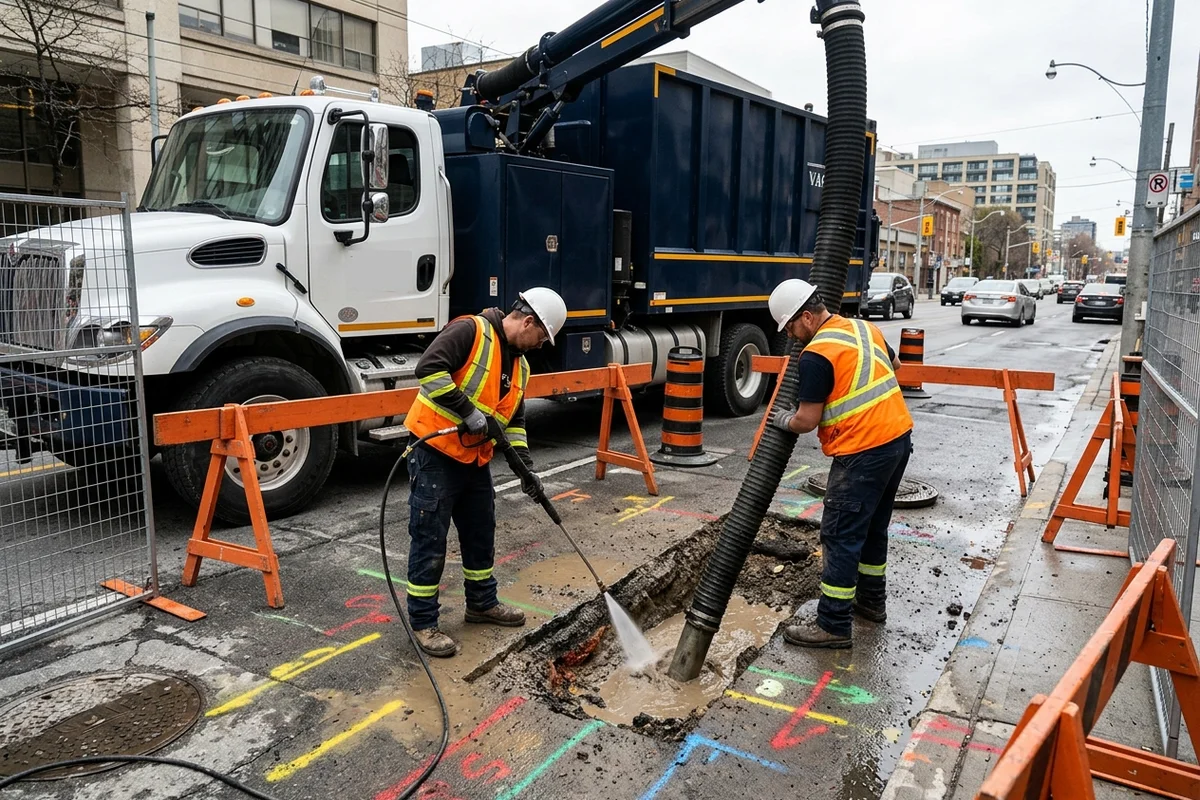
Hydrovac excavation — also written as hydro excavation, hydro vac excavation, hydro-vac excavation or vacuum excavation, and searched for as hydro excavation near me or hydrovac excavation near me — is the non-destructive digging method and the safe digging standard for buried-utility sites across Toronto. A triplex water pump on the truck sends 3,000-4,000 PSI water through a hand-held wand to cut soil loose. A positive displacement blower pulls up to 27 inch Hg of vacuum through a dig tube mounted on a telescopic boom, and the spoil slurry travels up the tube into a sealed debris tank. Nothing with teeth touches the ground, which is why non-destructive digging in Toronto has become the default method around live gas, hydro and telecom services.
That matters in Toronto more than almost anywhere in Ontario. The city has cast iron water mains from the early 1900s, Toronto Hydro duct banks, Enbridge gas mains and services, and three generations of Bell and Rogers telecom sharing the same boulevards and road allowances. From condo tower sites downtown to the older streets of East York, Etobicoke and Scarborough, the picture under the sidewalk is rarely what the record drawings show. Locate paint tells you roughly where a line is. Hydrovac tells you exactly where it is, how deep it sits and what it is made of.
Metro Hydrovac Toronto crews use it for utility daylighting, potholing for engineering design, backfill removal around live services and confined space digs. When the scope is narrow and linear, we switch to slot trenching. When it is a foundation, we run pile hole excavation on the same truck.
How the equipment works on site
- Triplex water pump and wand: 3,000-4,000 PSI, adjustable for clay, sand or frozen ground. Heated water from November to April.
- Positive displacement blower: 23-27 inch Hg vacuum lifts saturated clay, gravel and cobbles that a small vac truck would choke on.
- Telescopic boom and dig tube: positions the hose over the hole so the operator works at a safe distance from traffic.
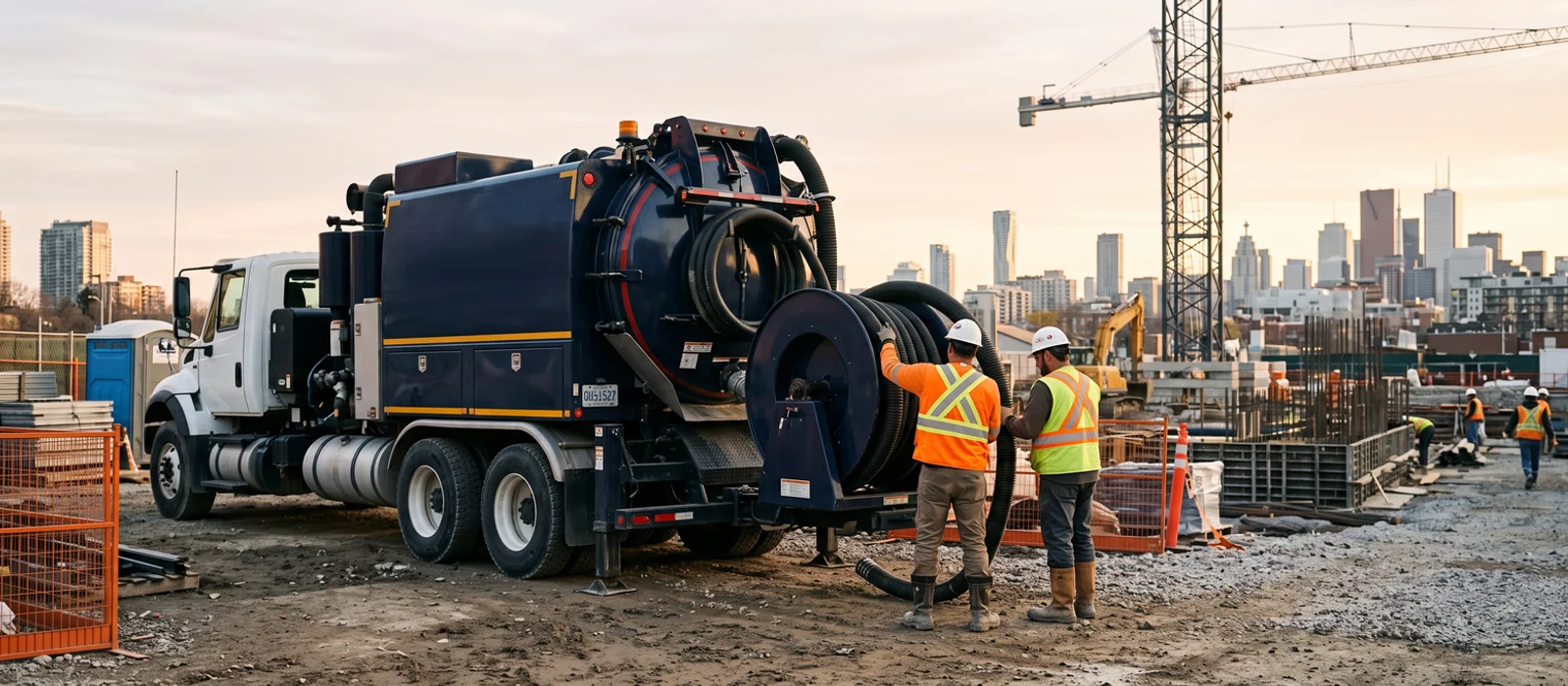
- Debris tank: 2,500 to 6,000 gallons depending on the truck. Tanks are TSSA pressure vessel compliant and inspected on schedule.
Hydrovac vs Traditional Excavation: Which Should You Use?
Traditional excavation uses a backhoe, excavator or hand-digging to remove soil. Hydrovac uses pressurized water and a vacuum truck. The choice comes down to what is buried under the site.
| Factor | Hydrovac Excavation | Traditional Excavation |
|---|
| Utility strike risk | Near zero — water cannot cut live services | High on congested lots |
| Speed on known-clean ground | Slower | Faster |
| Speed on congested right-of-way | Faster (no stop-and-probe) | Slower (stop and hand-dig at every locate) |
| Spoil handling | Lifted straight into the debris tank | Piled on site, loaded separately |
| Site footprint | Narrow — truck + hose | Wide — machine swing + spoil pile |
| Frozen ground | Heated water cuts through frost | Jackhammer or thaw required |
| Cost per cubic metre | Higher per m³ | Lower per m³ on open ground |
| Cost per strike avoided | $0 | $10,000-$150,000 per incident |
The decision is not either/or. On most of our GTA projects the first metre comes out with hydrovac to prove the utility picture, then the rest comes out with a machine. That gets the strike risk off the table and keeps the budget on the ground.
When Should You Skip the Backhoe?
The short answer: anywhere a buried utility is inside the locate tolerance zone, or anywhere you cannot afford to guess. In practice that covers most of the work we do across the GTA.
- Crossings and tie-ins. Every time new pipe, conduit or footing crosses an existing service, the crossing should be exposed first.
- Design test pits. Engineers need real depths before stamping drawings. A test pit costs a few hundred dollars; a redesign after a conflict costs weeks.
- Digging beside live services. Backfill removal around energized duct banks or pressurized gas is hydrovac work under CSA Z247.
- No room for a machine. Underground condo garages, mid-rise courtyards, Leslieville and Annex laneways and rooftop drains where a backhoe cannot fit.
- Frozen ground. Hot water gets through frost that slows a bucket to a crawl.
Field note from our crew
Running a hydrovac without ON1Call locates is like merging onto the 401 without checking your mirrors. We will not start a dig without a valid ticket, everytime, even when the site super swears nothing is down there.
How Does Hydrovac Compare to Open-Cut Digging?
| Factor | Open-cut with backhoe | Hydrovac excavation |
|---|
| Utility strike risk | High inside tolerance zones | Near zero, water does not cut jackets |
| Footprint | Wide trench, large spoil pile | Keyhole or narrow trench, spoil in tank |
| Restoration | Large asphalt and sod repair | Small patch per hole |
| Frozen ground | Slow, often stopped | Heated water cuts frost |
| Hourly cost | Lower | $280-$450 CAD |
| Cost of one strike | $10,000 to $100,000+ CAD | Avoided |
Open-cut excavation around a known fiber line is like a Halloween-store scissors: cheap, fast, and you’ll regret the result for months.
How We Compare
| Feature | Typical excavation contractor | Metro Hydrovac Toronto |
|---|
| Fleet and operators | Rented trucks or subcontracted crews | 3 owned trucks, Red Seal operators, zero subcontracting |
| Field record | Photo of the open hole | Depth, size, material and offset logged at every exposure |
| Inspector sign-off | Re-visits common | 100% first-visit utility coordination approval |
| Pricing | Quoted per job on request | $280-$450 CAD/hr published, disposal and mobilization on separate lines |
| Strike record | Not published | Zero utility strikes in 2,000+ projects |
What Moves the Number on Your Hydrovac Quote?
Five things move the number on a hydrovac quote, and every one of them appears on its own line:
- Hours on site. Soil type, depth and the number of holes drive time. Clay and frozen ground take longer than sand.
- Truck size. The 6,000 gallon unit costs more per hour but often saves a dump trip, which saves an hour.
- Disposal. Slurry goes to a licensed facility and is billed by load.
- Mobilization. One line, published up front. No hidden yard-to-site surcharges.
- Timing. Scheduled excavation is booked during business hours. Weekend work runs $500-$700/hr.
Commercial projects from the Port Lands to North York, Vaughan and Mississauga get a free on-site assessment. The Metro Hydrovac lead technician brings a tank capacity worksheet, the locate map and disposal options, so the quote you recieve is built on your actual site, not a guess.
Which Ontario Rules Govern a Hydrovac Dig?
Every excavation follows Ontario Regulation 213/91 for construction projects, including trench protection whenever a worker enters a hole deeper than 1.2 m. Ground disturbance near utilities follows CSA Z247. Locates come through Ontario One Call, and work on City of Toronto property also follows Toronto Municipal Code 847. Truck tanks are TSSA pressure vessel compliant. We carry $5M commercial general liability, $2M property damage and full WSIB coverage for every crew member.
How Long Does a Pothole Take? Production Rates by Soil Type
A single 4-foot utility pothole in Toronto sand or loose fill takes 15-25 minutes from first spray to inspection-ready. The same pothole in wet Southern Ontario clay or the dense glacial till under much of North York and Scarborough runs 30-45 minutes because the 3,500 PSI wand needs more passes to break the clay bond. Frozen ground in January takes 45-60 minutes per pothole until the heated-water system catches up with the frost line. Our Vactor 2100i trucks average 8-12 potholes per day in standard conditions, 5-8 per day in heavy clay or deep frost, and 15+ per day on long fiber corridor runs where the hose stays in one hole and advances in small increments.
Larger excavations scale by volume. A 10-foot by 10-foot test pit at 4-foot depth is roughly 11 cubic yards of soil. Our 2,500-gallon tank fills at that volume in 2-3 hours, drives to disposal and back in 1 hour, and resumes. One 8-hour day clears 15-25 cubic yards of controlled excavation. Everytime we quote hours on a job, those numbers are what we work from.
What Happens on Dig Day: Site Setup to Backfill
On arrival we confirm the Ontario One Call ticket number against your paint marks, walk the site with your supervisor, and photograph every locate flag before the wand comes off the rack. The truck stages where the boom reaches the dig without crossing live traffic, cones and signage match your traffic management plan, and the hose runs with a clear path to the hole. First spray starts within 15 minutes of arrival.
Each exposure follows the same loop: 3,500 PSI water loosens the top 6-12 inches of soil, the 27 inch Hg vacuum lifts the slurry into the debris tank, we check depth with a probe rod, photograph the utility, record material and offset in the field book, and move to the next hole. Mid-shift we stop for a tank dump at a licensed MECP receiving facility if the truck is near capacity. End-of-day we hand backfill holes to spec with excavated soil (if clean) or imported fill, sweep the site, and leave the depth log plus photos with your foreman. Every job is covered by our written workmanship warranty, from first spray to final sign-off.